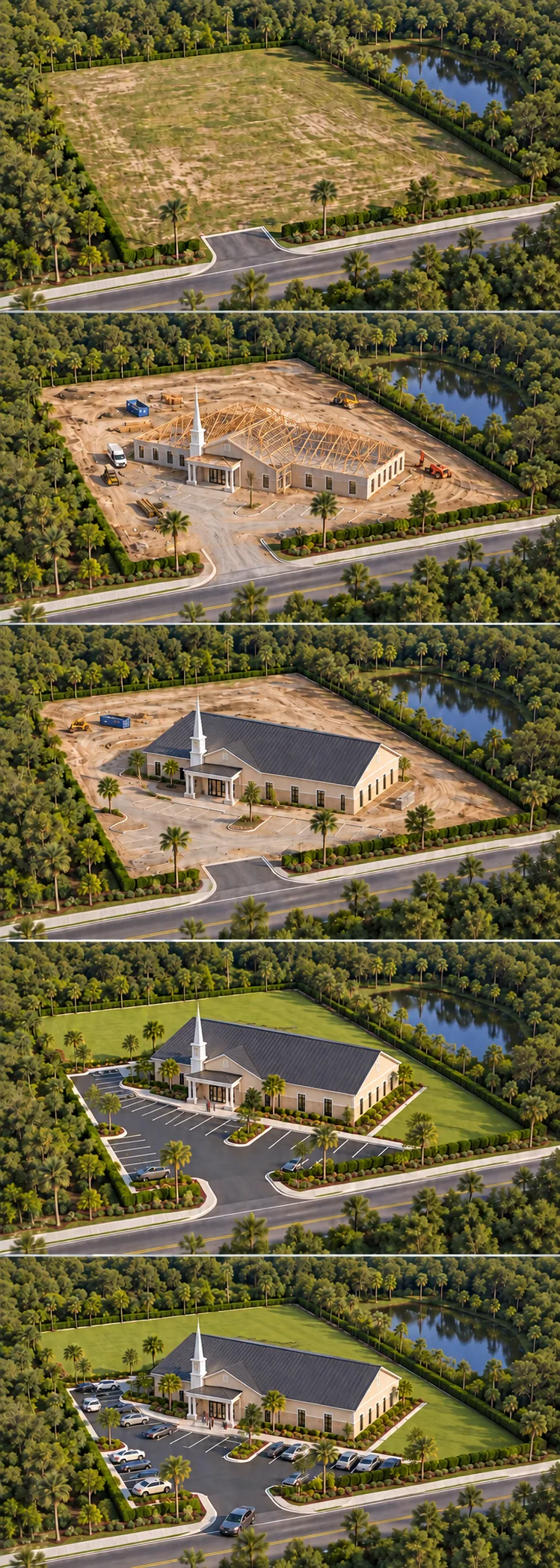
A conceptual proposal for institutional discussion. Space requirements, location and terms remain subject to validation.
01 / 05
Vacant land
CONCEPTUAL ANIMATION · NOT AN ACTUAL SITE OR APPROVED DESIGN
PRELIMINARY PROPOSALVersion 1.8 · October 27, 2026Under study · institutional approval pending
02 / THE SITUATION AND ALTERNATIVES
Four alternatives. One community need.
Sharing a chapel, adapting a commercial property or building an owned property can each be appropriate. A fourth path is to lease a simple chapel built around the required location and program.
Alternatives to assess on the same basis
Alternative
Why consider it
What to validate
01 · Share an existing chapel
A place already suited to worship and Church activities.
Available meeting times, capacity, travel distance and weekday use.
02 · Acquire land and build traditionally
Ownership and a program developed for long-term needs.
Upfront capital, delivery time, location and the long-term property commitment.
03 · Lease and adapt a commercial property
An existing property may offer a suitable location and size.
Renovation in a leased property, layout, reverence, weekday activities, parking and total adaptation cost. Suitability varies by property.
Our proposal
04 · Lease a simple, purpose-built chapel
A program tailored to the community, with the timing flexibility of a lease.
Investor structure, site feasibility, delivery, rent, total occupancy cost and contractual responsibilities.
No alternative is presumed cheaper or suitable without a comparable study. An existing commercial property may work well when its location, layout and adaptation requirements fit the program.
03 / THE BUILD-TO-SUIT LEASE
A suitable chapel. Through a lease.
A space suited to worship and weekday activities in the area the Church needs, without requiring its own land acquisition and construction now. Institutional, technical and contractual review still applies.
A
Suitable land
The investor identifies and evaluates sites in the area defined with the Church. Selection depends on permitted use, physical conditions, access and infrastructure.
B
A purpose-suited property
The investor develops and constructs a property suited or adaptable to the validated program, in accordance with agreed designs, permits and criteria.
C
An initial lease
The Church considers occupying the property under a lease. A term of three years may serve as an example for discussion, with duration and terms to be negotiated.
WHAT THIS APPROACH SEEKS TO OFFER
Seek competitive rent and an appropriate total occupancy cost, with acquisition and construction organized by the investor.
Compare rent together with adaptations, maintenance, insurance, taxes, utilities and delivery or exit obligations, as allocated in the lease. No rent or savings have been established.
Compare compact and expanded layouts +
CONCEPTUAL LAYOUTS / NOT TO SCALE
Two ways to organize the building.
Compare circulation and the administrative program before setting dimensions. These are spatial diagrams, not floor plans or engineering approvals.
COMPACT
One lateral corridor
Possible use by 1–2 wards, with schedules to validate.
Sacrament hall
Corridor
Bishopric and clerk offices
Shared teaching and support spaces
Administration grouped on one side. Study whether a future second corridor and additional program could be feasible; expansion is not assumed.
EXPANDED
Two lateral corridors
Potential use by up to 4 wards, with shared spaces and validated schedules.
Bishopric and clerk offices
Corridor
Sacrament hall
Corridor
Bishopric and clerk offices
Shared teaching and support spaces
Administrative groups on both sides of the central hall, following the broader reference concept. Four wards would use different schedules, not four simultaneous sacrament meetings.
Room counts, restrooms, seating, circulation widths, parking, accessibility, exits, structure and future expansion require program, code and institutional validation. No areas, costs or occupancy capacity are established by these diagrams.
PROPOSED CONTRACTUAL STRUCTURE
The Church’s proposed commitment would be limited to the agreed commercial lease, without an obligation to acquire the land or building, or to guarantee the investor’s investment, debt or construction.
At the regular end of the lease, after fulfilling agreed rent and handover or return obligations, the Church could choose not to renew or buy and leave without an additional penalty for that choice or continuing responsibility for the investor’s investment.
These are terms to negotiate, not an existing agreement or an automatic legal rule. They do not permit early departure without rent, damages or other obligations that remain due.
Explore options after the initial lease +
05 / FUTURE POSSIBILITIES
Options to consider after the initial lease.
The contract may address future options that make sense for both parties. None of the options below has been granted or approved.
01
Continue using the property
If the property continues to serve the community, the parties may consider renewing the lease, with a new term and negotiated conditions.
02
Respond to changing needs
Adaptation or expansion will depend on available space, permits, funding and agreement on who carries out and pays for the work.
03
Examine a potential purchase
A purchase preference could be negotiated as an optional future term. This proposal creates no existing purchase preference, right, price or obligation to buy or sell.
04
Conclude the occupancy period
Under the proposed structure, the Church could leave at regular expiry after meeting the agreed lease obligations, without an additional penalty merely for declining renewal or purchase. Early termination would follow separately negotiated terms.
04 / THE PILOT PROJECT
Validate one need. Structure one pilot.
Validate demand, the service area, the space program and lease terms with the responsible Church department. These inputs will guide the structure to be proposed to an investor.
01
Demand, area and program
Confirm community needs, locations to consider, meeting capacity and the workable scheduling of two to four wards.
02
Site, design and feasibility
Review permitted religious use, land conditions, the simplified building, parking, accessibility, exits and required approvals.
03
Total cost, lease and investor
Develop comparable costs and lease terms. The investor’s proposed role is acquisition and construction; the Church validates requirements and evaluates occupancy. Allocate maintenance, taxes, insurance, adaptations and exit responsibilities before commitment.
04
Decide, then evaluate the pilot
Proceed only through the necessary institutional, technical and contractual decisions. If the pilot works, the approach could be considered in other regions; replication is not an approved program.
The next step is institutional dialogue. Presenting this concept does not authorize a purchase, contract or start of construction.